

TM9-4120-398-14
(10) If possible make use of terrain features such as trees and buildings to provide a shaded location. This will
minimize the cooling load on the air conditioner.
(11) If possible avoid locations where the condenser and fresh air intakes will be laden with dust, dirt, soot, smoke,
or other debris.
b. Place the air conditioner approximately 6 to 7 feet from the structure to be cooled with front of unit (figure 4-2)
pointing toward the building. Position the air conditioner for duct attachment free of kinks or sharp bends to allow
unobstructed passage through air delivery and air return ducts.
a. Duct Connections. Two flexible ducts are contained in the storage space inside the air conditioner. To remove the
ducts and attach to the air conditioner duct adapters, proceed as follows:
(1) On the left side of air conditioner observe two hinged panels. The panel toward the rear (figure 1-1) gives
access to the interior storage space. Open the panel by rotating the lock fasteners 1/4-turn to the left (counter-clockwise).
Loosen the two wing nuts on each duct rack and lift out the flexible ducts and racks. Stem racks inside condenser compartment
after removing ducts.
(2) Remove the duct adapter flange covers from the front of the air conditioner. Store covers inside condenser
compartment.
NOTE
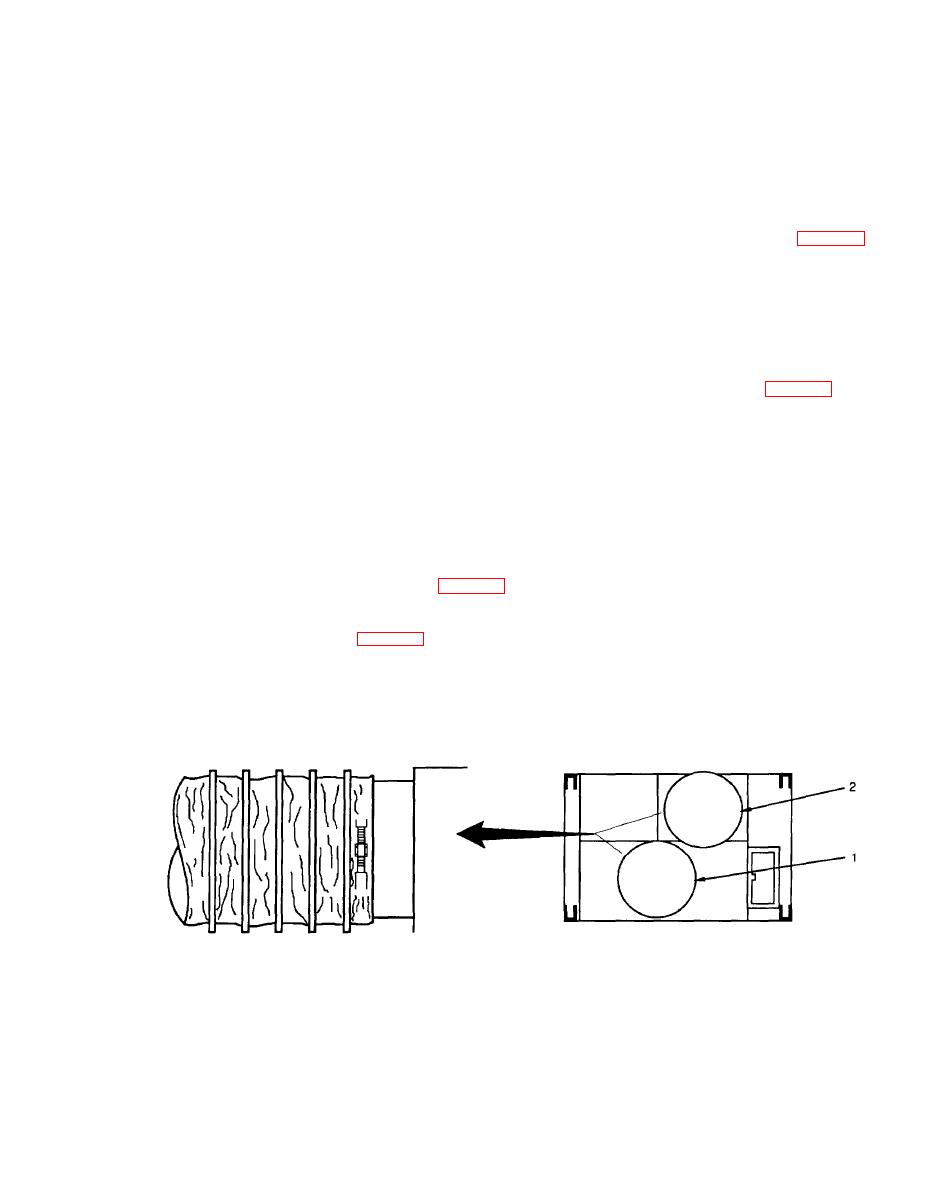
Observe airflow directional arrow on duct. The 7foot duct attaches to the air return (1) and the 9-foot
duct attaches to the supply (2) as shown in figure 4-3.
(3) Slide the end of the duct onto the duct adapter. When properly in place, the hem containing the strap is passed
over the raised rim of the port flange (figure 4-3). Make sure the strap ends are positioned to allow adequate space for working
with tools.
